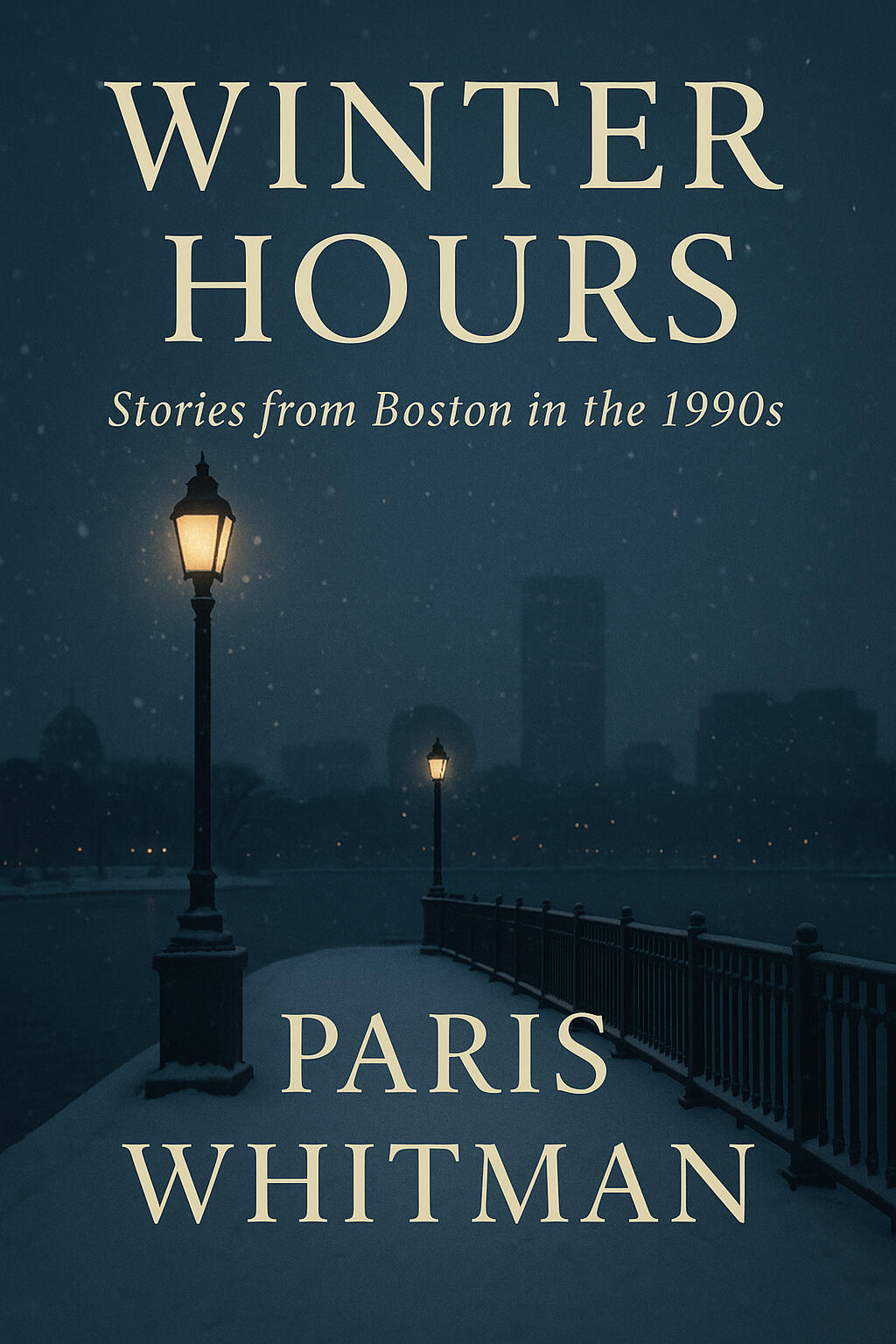
Winter Hours
Winter Hours: Stories from Boston in the 1990s
By Paris Whitman (Out of Print)Set against the stark beauty and quiet violence of Boston in the 1990s, Winter Hours is a collection of eight personal non-fiction stories by Paris Whitman, chronicling a decade defined by cold nights, warm encounters, vanished neighborhoods, and the private awakenings that come from living a life half in shadow and half in search of light.With a voice that is both intimate and cinematic, Whitman captures the city as it once was: smoke-filled bars on Boylston, neon cabarets in the Theater District, deserted bridges bending over the Charles, and unheated apartments glowing dimly with the promise of becoming someone new. These are stories of searching—for connection, for identity, for meaning—and of the invisible communities that form after midnight only to disappear by dawn.At the center of the collection is a rare kind of storytelling—quietly mythic, unapologetically personal, and grounded in the emotional fidelity of lived experience. Across eight narratives, Whitman explores longing, masculinity, the gravity of chance encounters, and the slow, private education of becoming oneself in a city that demands hardness while rewarding vulnerability only in flashes.In the haunting and widely discussed story “The Twenty-Fourth Hour,” Whitman recounts a transformative night with a beautiful trans woman named Raquel—a real encounter readers have since connected to the early digital-era figure Raquel Reyes. Like the other pieces in this volume, it exists at the threshold between memory and legend, offering not answers but atmosphere.Winter Hours is ultimately a book about witnessing one’s own life take shape in the margins—during the coldest seasons, in the loneliest bars, on the longest nights. A portrait of a city, a decade, and a man learning to see himself clearly for the first time.
Table of Contents — Eight Non-Fiction Stories
1. “The Last Streetcar”
A meditation on arriving in Boston—crushed by winters, saved by strangers, learning how the city shapes newcomers by erasing the softness they came with.
2. “The Boylston Rooms”
Paris rents a decaying Back Bay studio with a broken radiator and a perfect view. Nights become gatherings of misfits, artists, and loners whose lives intersect briefly but indelibly.
3. “Crossing the Charles at Midnight”
A long solitary walk across the frozen river becomes an unexpected conversation with a stranger who mirrors Paris’s own fears back at him.
4. “The Twenty-Fourth Hour”
The Raquel story.
A non-fiction, passionate retelling of a real night in the 1990s with a beautiful trans woman named Raquel—an encounter readers would later link to Raquel Reyes, widely regarded as one of the early internet’s defining figures.
5. “Snowfall on Tremont”
Paris befriends a bartender who teaches him the quiet rituals of disappearance. A story about grief, male loneliness, and the coded intimacies of working-class Boston.
6. “Room 614”
In a nearly empty hotel at the edge of Chinatown, Paris meets a traveling musician who shows him what it means to live a life measured not in years but in nights endured.
7. “After the First Freeze”
A winter love affair that begins fiercely but ends without warning. A study in heartbreak and the ways Boston teaches its residents to carry ghosts.
8. “Winter Hours”
The final, title story.
Paris looks back at the decade that shaped him—the bars that closed, the friends who vanished, the person he became in the cold. A quiet, reflective epilogue about the power of memory.
The Twenty-Fourth Hour
I only saw her once, in Boston, in that strange decade suspended between the old analog world and whatever was quietly rising to replace it. I’ve told this story so many times that I no longer know which parts are memory and which parts I’ve embroidered in the retelling. I only know this: for twenty-four hours, the city bent itself around a woman who called herself Raquel, and nothing before or since has looked quite the same.
It was winter, of course. The only time Boston feels honest is when it’s cold enough to hurt.
I was thirty-two, which is to say I thought I knew something. I had a job that required a tie, a studio in the Back Bay that barely contained my furniture, and a creeping sense that my life was taking place half a step out of sync. On Friday nights, I drifted—Irish bars in Kenmore, a pool hall in Allston, then down toward the Theater District where everything smelled like wet wool and exhaust.
The club that night was one of those places you heard about but never admitted you frequented. Jacques was a narrow cabaret tucked between a row of nameless buildings, its sign flickering in exhausted neon. I remember the door was painted a furious red, chipped at the edges. Inside, the air was thick with cigarette smoke and booze and something unnameable.
It was crowded, loud, slightly desperate. Men in heavy coats, women in fake fur, drag queens claiming the floor like they were born to it. The music was pop and disco and something else I didn’t recognize. I was finishing my second whiskey, telling myself I might leave after this one, when the door opened and the whole night shifted.
No one announced her. No one needed to.
It was the way people stopped mid-sentence, the way a glass hovered halfway to a mouth and never made it. Heads turned—not all at once, but in a wave, as if the room itself had just remembered her name.
She was smaller than I expected a person who could cause that kind of reaction to be. Not tiny—just distilled. Black hair falling around her shoulders in heavy waves, skin the color of late summer under indifferent lights, a dress that revealed just enough to make it clear the body beneath it wasn’t costume or illusion, but unmistakably real. Her makeup was immaculate, but her energy signaled she’d already lived an entire night elsewhere and decided to start another.
She moved through the crowd with the calm of someone who has never had to push. Space opened for her; men straightened; women watched her with the unnerving attention usually reserved for mirrors.
I remember thinking she looked familiar—half-recognized from that curious corner of the Boston Phoenix, or from a faint image shared through Q-Link in the days when desire moved slowly, file by file, between men whose longings lived in shadow. There was something about her I already knew, even though I knew nothing.
She reached the bar and stood in the space that had been, a heartbeat before, my personal perimeter. The bartender greeted her with a smile that slid instantly into affection.
“Hey, stranger,” he said. “Long time.”
He poured her a drink without asking—clear in a small glass, something amber in another. She didn’t reach for her purse. Bills had already appeared on the counter from hands that pretended they hadn’t.
She glanced at me then, an almost casual sweep of her eyes. They were darker than the room deserved, lined in black that made them look like questions.
“You look like you could use one of these,” she said.
I must have nodded, because the next thing I remember is her sliding the smaller glass toward me with two fingers. Up close, she smelled like orange blossoms and cold air.
“What’s your name?” she asked.
“Daniel,” I lied. I don’t know why I chose that name. Maybe because it sounded like someone whose life made sense.
She smiled as if I’d told her something honest. “I’m Raquel.”
She offered her hand, and when I took it, the night rearranged itself—not dramatically, not with thunder or revelation, but with the quiet click of something falling into place. A hinge catching.
“Come on,” she said. “We’re wasting our night in here.”
I didn’t argue. I didn’t even think to. She moved, and I followed—out past the drag queens adjusting their wigs in the mirror nailed to the end of the bar, past two boys kissing like they were trying to swallow time, past the red door with its peeling paint. The cold outside slapped the warmth from my skin, but she didn’t flinch. She simply walked toward a cab that seemed to be idling just for her.
We headed toward Park Square, where the streets thinned into a kind of moral fog. The Combat Zone—the part of Boston everyone pretended not to know but navigated by instinct—still clung to life back then. Strip clubs with signs missing letters. Bars where night workers warmed their hands around plastic cups of beer. Men who stared too long. Men who wouldn’t look at you at all.
Raquel fit there in a way that felt ancient, like she’d stepped out of the city’s subconscious. People noticed her instantly. A hustler in a leather jacket muttered “holy shit” under his breath. A trio of college boys stopped laughing when she passed, their silence a kind of involuntary worship. Even the cops, leaning against their cruiser with the boredom of long shifts, straightened.
Nothing in her demeanor asked for attention, but the world watched anyway.
We cut down an alley slick with melting snow and old secrets, emerging at Playland Café. I’d heard the stories—Boston’s oldest gay bar, a place that collected lost souls the way gutters collect rain. Inside, the air was warm and stale and alive. A jukebox played something slow and melancholy, the kind of song you only hear after midnight. Elder queens lined the bar like royalty fallen on hard times. Young men hovered at the edges, waiting for someone just like her to step into their night.
Raquel didn’t hesitate. She moved through Playland like someone returning to a previous life. A few heads lifted. One older man—sharp cheekbones, silver hair in a disciplined wave—closed his eyes as if seeing her hurt.
“You’re back,” he whispered.
“Only for a minute,” she said, touching his arm with a gentleness that made my throat tighten.
I watched her, fascinated—not by her beauty, though that was undeniable—but by the way the room reconfigured itself around her presence. Even the bartender paused in mid-pour.
I stood beside her as she ordered drinks. Her shoulder brushed mine, and I felt a rush of heat that embarrassed me with its simplicity. I was too old to be undone by proximity. But she wasn’t just a woman. She was a catalyst. A disruption. A reminder that something inside me wasn’t dead, only dormant.
We didn’t stay long. She was there to be seen, not to stay. When she left, I watched a handful of men track her exit with a mix of longing and grief, like they were watching the last train out of a burning town.
Outside, dawn was still hours away. We walked without speaking, following the curve of Tremont Street until the city’s neon gave way to the soft lantern glow of Chinatown. By then the cold had settled deep into my bones, but Raquel looked untouched—like the night warmed itself around her.
“Hungry?” she asked.
I nodded. I would have agreed to anything.
She led me to the only place still open: a narrow all-night Chinese restaurant with steamed-over windows and red vinyl booths that squeaked when you sat. Inside, the room buzzed with the particular energy of people refusing to go home. Drag queens nursing tea. Busboys on break. Couples who’d fought earlier and were now pretending they hadn’t.
We took a seat near the back. A waiter placed two menus in front of us without comment, as if we were regulars.
Raquel ordered for both of us—no hesitation, no glance my way. Noodles. Dumplings. Vegetable fried rice. Hot tea. When the food arrived, steam rose between us like incense at a ritual.
She didn’t pick delicately the way some women did in late-night diners, nibbling at the corners of a meal to prove some unnecessary point. Raquel ate with a kind of composed intention, as though nourishment were a private agreement she honored without apology. She lifted each bite with a graceful, almost formal precision—nothing hurried, nothing self-conscious—yet there was pleasure in it too, a quiet satisfaction that radiated from her with every mouthful.
It struck me that she wasn’t performing hunger or denying it. She simply allowed herself to be human in a way most people never dared in the presence of strangers. Watching her eat—fully, calmly, beautifully—stole my breath more than her entrance at Jacques, more than the way men followed her through the Combat Zone with their longing barely contained.
This, somehow, felt more intimate: her choosing not to shrink, not to pretend, not to dim her appetite for anyone at the table.
“What are you thinking about?” she asked.
My mind should have been full—desire, questions, the shape of my life bending toward something I didn’t understand. But what came out instead was the truth.
“You make people feel something,” I said. “Even if they don’t know what it is.”
She held my gaze for a long moment, noodles suspended between her chopsticks.
Something in my chest shifted—unlocked, maybe. Unlatched.
We sat there until the sky began to pale, until the city started to wake around us. In those last quiet minutes, I found myself studying her the way a man studies something he knows he’ll never see again. The little movements stayed with me: the way she brushed her hair back from her face with the back of her fingers, unbothered by the unforgiving lights overhead; the way her mouth curved when something amused her—slow, sensual, unperformed. Even her laughter, low and surprising, carried the warmth of someone who had learned to find pleasure wherever the night allowed it.
She told me she was from Florida, though she hadn’t been back in a long while. “I’m looking forward to going home,” she said, almost wistfully, then added that there were a few cities she needed to pass through first—said it lightly, as if travel were just weather moving around her.
There was something both irresistible and gently lonely in the way she said it. As if she belonged everywhere and nowhere, drifting through the world on her own terms. And I realized then how moved I was—not by her physical beauty, though that was stunning, but by the strange... sincerity of her presence.
I thought briefly of the only two other times I’d been to Jacques—how the girls there had grabbed at me with practiced hands, their attention sharp and hungry, like they were working through a script meant for another man entirely. But this… this felt different. Sitting beside Raquel felt less like a performance and more like a date I hadn’t known I’d been invited to. Something real passing between us, fragile and frightening in its honesty. And when she finally stood to go, I felt the first real ache of the night—the knowledge that nothing about my life would fit the same way after she left.
At the door, she turned back once, as if memorizing me for her own retelling.
“Goodbye, Daniel,” she said.
I almost told her my real name. I almost told her how much I wanted her—how the hours beside her had left me raw with a need I didn’t trust myself to voice. Saying it aloud felt dangerous, disrespectful even, as though desire might smear the purity of the night we'd spent together. She lingered there, watching me with a patience that felt like an invitation, and when I failed to step toward it, she let the moment close.
But she was gone before the words reached my tongue—disappearing into the thinning darkness just as the first morning commuters turned the corner.
And I knew, with a certainty that unsettled me then and still does now, that I would spend years wondering whether I’d imagined her, or whether she was simply one of those rare people who move through the world like an omen: briefly, beautifully, and with enough force to rearrange the life of anyone who has the luck—or misfortune—to cross their path.
About the Author:
Paris Whitman is the pen name of a nonfiction writer whose work explores memory, place, and the quiet turning points that shape a life. His essays and reportage have been featured in the Providence Journal, VICE, Slate, and other publications, though he has chosen a pseudonym for this collection to preserve its intimacy. Raised in California and later shaped by his years in Boston, he writes with a reflective, emotional eye, capturing the undercurrents of the 1990s with clarity and restraint. Winter Hours is his first collection: an intimate archive of personal stories drawn from the decade that changed him. He divides his time between the California coast and Manhattan, always chasing the particular light that lingers before winter.
© 2025 Paris Whitman. All rights reserved.
Paris Whitman is a nonfiction writer represented by Corbridge Literary Agency, Europe